


15 Feb 5 Major Benefits of Installing Terrazzo

5 Major Benefits of Installing Terrazzo (And Why It Outperforms Other Commercial Flooring)

Terrazzo delivers lower lifecycle costs, longer performance lifespans, excellent flexibility, LEED-qualifying sustainability, and commercial-grade surface resistance, making it the highest-long-term-value flooring for schools, hospitals, airports, and commercial buildings.
Terrazzo is used primarily for flooring, but today it can be engineered as wall panels, stair treads, and other precast terrazzo applications. Together, the floor and precast blend together to form a seamless appearance for high-functioning spaces. There are different methods of installing terrazzo. Poured-in-place epoxy terrazzo has been a favorite among architects for its expansive design opportunities. Cement terrazzo is another popular option known for its vintage appearance and is highly suggested for use in exterior applications. And then we have precast terrazzo, a form of terrazzo pre-made in a controlled environment and later transported to the construction site for installation.
This guide covers each benefit with the specificity architects, building owners, and facility managers need to make confident specification decisions.
What is Terrazzo, and Why Does it Matter for Commercial Projects?
Terrazzo is a composite flooring material made by combining aggregate chips (marble, glass, shell, etc.), with an epoxy or cement binder, poured in place or precast, then ground and polished to a smooth, seamless finish.
Three main installation types exist:
- Epoxy terrazzo (poured-in-place): Most common in modern commercial projects. Has a thinner profile at 3/8″ with higher strengths and design flexibility. Suited only for interior applications.
- Cement terrazzo: A traditional system with thicker profiles. Suited for both interior and exterior applications, and common in restoration projects.
- Precast Terrazzo: Factory-fabricated under controlled conditions; commonly used for stairs, wall base, countertops, and tiles. Good complement to the flooring system.
The choice of system affects cost, lifespan, and application suitability. All covered in our next section.
Concord Terrazzo Company specializes in providing epoxy terrazzo materials, including epoxy resin and aggregates, and manufacturing epoxy terrazzo precast for commercial projects.
Benefits 1: Longevity
Terrazzo lasts 40-100+ years with proper care, often exceeding the functional life of the building it’s installed in.
Many commercial flooring materials (carpet, LVT, ceramic tile) require full replacement every 10-20 years. Terrazzo, once installed, requires no replacement cycle. Buildings, especially historic courthouses and airports, retain their original floors that have served decades of heavy foot traffic without replacement. Terrazzo can be easily restored to its original luster.
Why it Lasts:
- Compressive strengths exceed a minimum of 10,000 PSI in epoxy systems
- The matrix resists cracking under heavy loads
- No grout lines means no failure points like chipping
- Surface damage like scratches, is restorable through refinishing
Specifying terrazzo reduces the building owner’s exposure to renovation disruption, replacement costs, and downtime, important for healthcare and airport environments where floor replacements can create operational shutdowns. The durability of terrazzo allows the surface to last for years with minimal maintenance.

Benefit 2: Low Lifecycle Costs
Terrazzo carries a higher upfront installation cost than alternatives but delivers the lowest total cost of ownership of any commercial flooring system. It’s an affordable solution for building owners.
When you factor in the one-time terrazzo installation cost combined with low frequency in replacement costs, terrazzo is among the lowest life-cycle costs in flooring. Here’s a comparison among flooring:
| Flooring Type | Avg Upfront Cost ($/SF) | Avg Lifespan | Maintenance Cost | Total Cost of Ownership |
|---|---|---|---|---|
| Epoxy Terrazzo | $20-$35 | 40-100+ Years | Low | Low |
| Polished Concrete | $8-$15 | 20-30+ Years | Moderate | Low |
| Ceramic Tile | $5-12 | 15-20 Years | Moderate | Moderate |
| Carpet | $3-8 | 7-10 Years | High | Very High |
| LVT | $3-7 | 10-15 Years | Moderate | High |
Costs for terrazzo can vary by region, project size, and system type. For an accurate quote, a terrazzo contractor can provide project-specific estimates in your area.
Reviewing the total cost of ownership with owners is one of the clearest justifications for using terrazzo in public sector projects. It’s quantifiable and displays total net savings over the building’s life.
Benefit 3: Design Capabilities
Terrazzo supports unlimited custom color, pattern, logo, and aggregate combinations. No other flooring system matches its design range.
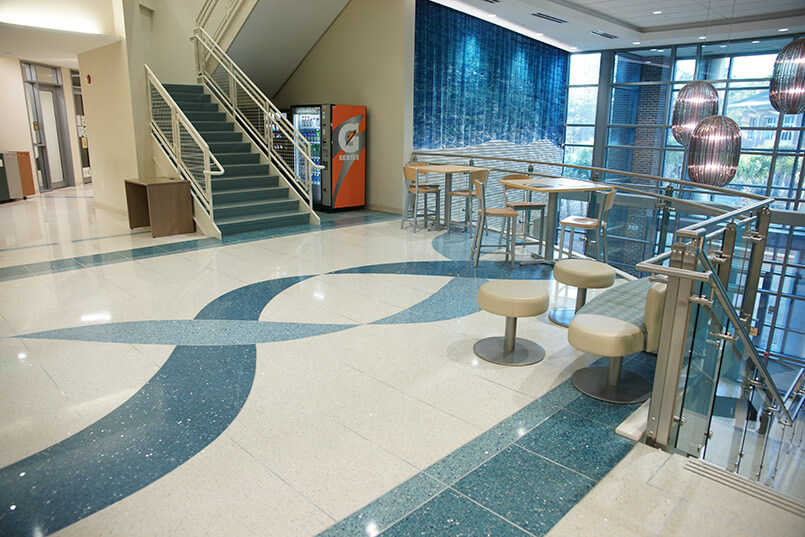
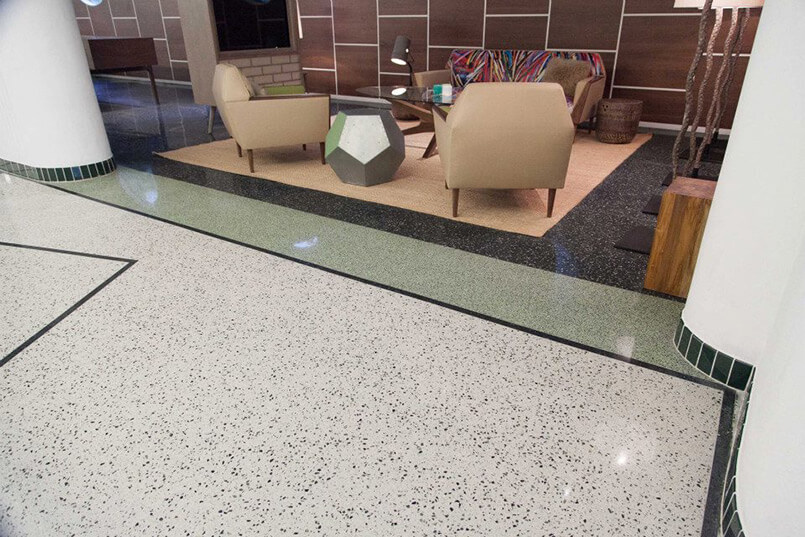
Terrazzo is created by combining any selection of aggregates, ranging from marble to glass chips, with any choice of resin color. The results make a difference! For designers, terrazzo is a highly personalized experience.
Design variables include:
- Matrix color: Epoxy resin accepts any color pigments.
- Aggregate type: Marble, recycled glass, mirror, Mother of Pearl
- Aggregate Size: #00 to #8 chip sizes (See manufacturer for availability)
- Divider Strips: Brass, zinc, aluminum in custom patterns
- Waterjet inlays: Cut logos, murals, or wayfinding graphics embedded into the floor.
Beyond floors, terrazzo extends to:
- Stair treads and risers
- Wall panels and cladding
- Countertops and vanities
- Tabletops
- Commercial tile
For architects and interior designers, terrazzo becomes a design asset providing freedom to design freely. This flexability is valuable for branded environments and high-visibility public spaces.
A distinctive terrazzo design enhances the perceived quality and brand identify for a building. A signature terrazzo floor also supports portfolio differentiation and award submissions for architecture firms. For building owners, a terrazzo floor can attract visitors and create welcoming experiences.

Benefit 4: Environmentally-Friendly & Sustainable.
Terrazzo qualifies for LEED credit, uses recycled contents, and contains zero volatile organic compounds (VOCs), making it a highly sustainable commercial flooring system.
Terrazzo manufacturers like Concord Terrazzo Company promote healthy environments by using sustainable materials. TERRAZZCO’s epoxy resin systems consist of rapidly renewable materials and contain no volatile organic compounds which promote better indoor air quality. Even the divider strips and sealers used during a terrazzo installation are environmentally friendly.
Sustainability credentials:
- VOC-free: Epoxy terrazzo systems contain zero VOCs or low volatile organic compounds, improving indoor air quality (IAQ) during installation and throughout the building’s lifecycle.
- Recycled aggregate content: Post-consumer and post-industrial aggregates count towards LEED MR (Materials & Resources) credit.
- Locally sourced materials: The regional supply of materials reduces embodied carbon from transportation.
- No replacement waste: Terrazzo generates zero end-of-life waste over the same period that other flooring systems would cycle through multiple replacements. In fact, components of terrazzo can be recycled back into new floors after their lifecycle ends.
LEED credit categories terrazzo supports:
- MR Credit: Recycled Content
- MR Credit: Regional Materials
- EQ Credit: Low-Emitting Materials
Benefit 5: Resistant Surface
Terrazzo resists water, fire, chemical spills, heavy impact, and contamination. It’s a resilient flooring that outperforms other flooring materials on every major damage vector in commercial environments.
Resistance properties:
- Water resistance: Epoxy terrazzo is non-porous and impervious to moisture infiltration; a seamless floor eliminates standing water pathways.
- Fire resistance: The epoxy matrix is non-combustible under standard fire ratings
- Chemical resistance: Able to resist common spills (acids & solvents) without surface degradation.
- Stain Resistance: Non-porous surface prevents absorption; most spills wipe clean without residue.
- Slip Resistance: Terrazzo is inherently nonslippery. When paired with sealers, manufacturers recommend a compatible product with their terrazzo system that has a coefficient of friction comparable to other hard surface floors.
Ideal environments for terrazzo’s resistance profile:
- Healthcare
- Food service and commercial kitchens
- Education
- Transportation stations
- Industrial and laboratory spaces
A damage-resistant floor reduces the facility’s manager’s ongoing maintenance burden and eliminates risk for floor replacement. By considering terrazzo, it helps buildings achieve tangible operational savings and reduce liability.
FAQs About Terrazzo
Terrazzo Vs Polished Concrete - Which is Better for Commercial Flooring?
Both terrazzo and polished concrete are durable flooring options. Terrazzo outperforms polished concrete on lifespan, design flexibility, surface resistance, and lifecycle costs over the lifetime of the building. Polished concrete wins on upfront cost for short-term and budget-constrained projects.
Bottom Line: Polished concrete is cheaper to install. Terrazzo is cheaper to own over time.
Are there ways to reduce cost of a terrazzo project?
To better prepare to justify terrazzo’s cost to a building committee. Here are some strategies that may aid in cost reduction:
- Scale the Project: Combine flooring areas across multiple rooms or floors into a single mobilization. Per sq ft cost drops significantly above 5,000 sq ft.
- Simplify the Design: Eliminate custom designs for non-featured areas. Reserve design investment for lobbies and high-visibility zones. Also, select standard-sized aggregates over fine or Venetian sizes.
- Choose Precast for Appropriate Applications: Wall base and stair treads made via precast can come at a lower cost than poured-in-place.
- Phase the installation: Large campuses can install terrazzo in phases across capital budgeting cycles without disrupting design continuity.
About TERRAZZCO
TERRAZZCO Brand Products is a line of epoxy resin, precast, and aggregates distributed by Concord Terrazzo Company. TERRAZZCO® Brand products are produced with the intent of satisfying the U.S. Green Council’s LEED® Green Building Rating System. Our products are made from 100% solids and are completely VOC free which results in little to no off-gassing leading to improved air quality during installation and which is beneficial to the lifecycle of the building in which these products are installed. This factor contributes to your project’s LEED certification goals. In addition, TERRAZZCO® products are manufactured using renewable resources which can contribute to even greater LEED points.
Write to us at info@terrazzco.com if you have additional questions about our blog post “5 Major Benefits of Installing Terrazzo.” For more information on terrazzo, check out our blog where we post helpful tips and informational guides related to our products and our industry.