



25 Aug Creating a Color Match for Terrazzo



Creating a Color Match for Terrazzo
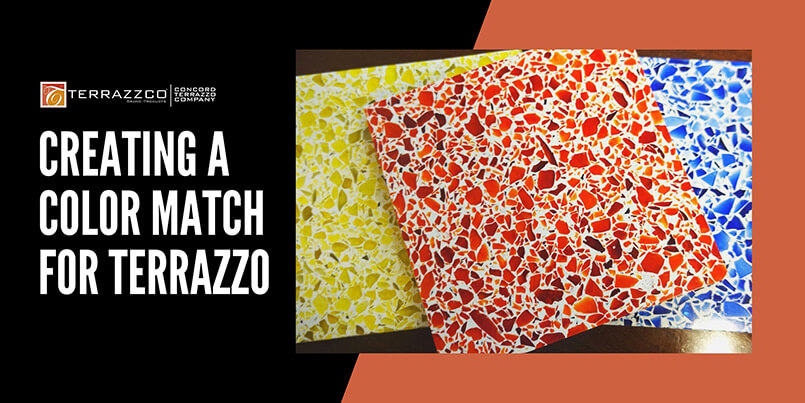
We may not be the first to tell you this, but terrazzo can come in different designs. Whether it be the color of the unique aggregates we have in stock or the color of the epoxy resin, we have a team of designers that can help architects match an existing floor design or a new terrazzo sample from scratch. We will show you how a color match is made.
Concord Terrazzo Company receives various requests from architects and designers requesting terrazzo samples for an upcoming project. One of our design specialists corresponds with these architects to understand the design they are seeking. Normally, we would ask the architects for a 4″ x 4″ puck or a color sample to proceed to the next step.
To create a swatch match, our design specialist sends the architect’s information over to a lab technician for review. The lab technician can either find a color match found in our database or if the color does not exist, they can create a physical sample.
Color Match to an Existing Sample
Provided with an existing terrazzo sample, the lab technician will review the samples using daylight at an angle. When inspecting the samples, the lab technician will notice the pigments and dispersion of material included in the terrazzo. On average, it takes about 15 minutes to conclude which colors are in the sample. Next, the lab technician will run it through a calibration device to recognize and reveal the closest color match. The database contains thousands of existing hues. One aspect to look for is the tolerance level. The tolerance level refers to how much error a sample can have before it goes beyond the color spec. Ultimately the goal is to have as little tolerance as possible. The smaller the tolerance level, the closer the sample is towards matching the correct color.
Based on the tolerance level, the database will indicate if a sample passes or fails a color match. When there is an exact color match, the lab technician will retrieve the recipe from the database and pass it along to the Mix Design Producer. The Mix Design Producer creates physical terrazzo samples. In this stage, the Mix Design Producer will gather aggregates from the warehouse and TERRAZZCO® Brand Epoxy to create a mold, usually circular. The Mix Design Producer will add marble dust and later grind and polish the sample to a smooth finish.
Afterward, the terrazzo samples are reviewed and sent back to the design professional for final approval. Once the samples are approved, they are sent back to the architects for them to view.
Creating a New Color Match
While our database contains multiple colors, sometimes we will need to add a new color to the database. Terrazzo can be made with any color; therefore, we work hard to produce as many recipes as possible. To begin, the lab technician can take a color index or a color that the architects provide and then determine which dyes to use. Next, the lab technician starts off by pouring a base into a container. Sequentially, new dyes are added until the mixture is close enough to the exact color. The entire process requires a lot of testing. During the whole process, the lab technician can alter the shade of the color as needed with a few drops of black dye to provide a darker hue or a few drops of white dye for a lighter hue.
Once the mixture is produced, the lab technician will test the color match on the calibration device for pass or failure. With each pass, the lab technician can turn the reigns over to the Mix Design Producer to create a physical sample. With each failure, the lab technician will continue to work until the mixture matches up with the color index or provided a color sample.
Concord Terrazzo Company supplies aggregates, manufactures precast terrazzo products, and produces epoxy resins as well. Would you like a customized terrazzo sample? Fill out our sample request form or contact Concord Terrazzo Company today!
Follow Us on Social Media:


